How I managed TXN CSPs in a choppy market.
On August 11, I sold one TXN $275 cash-secured put expiring that Friday. I collected $137.96 after the opening fee. By Thursday’s close, TXN was at $273.43, below my strike, with one trading day left.
I could have taken the shares and started selling covered calls. That’s what I did plenty of times last year when the market was healthier. Get assigned, sell calls, eventually get called away. Nothing wrong with that but this years regime is different. My goal with most CSPs is to collect premium without picking up shares. I’m not saying assignment is a bad thing.. Remember, we’re selling CSPs on shares we “wouldn’t mind holding long term”. I just don’t trust holding anything in THIS regime.
So I rolled TXN… Six rolls in all.
Each roll meant buying back the put I had sold (for more than what I collected in premium) and selling another one with a later expiration. If I could lower the strike and still get a net credit, great. If not, I kept the strike and got paid to wait one more week. I looked for pops when expiration was getting close, but I wasn’t going to push the new expiration a month out just to show a credit. Why? Because chop.
Here is the whole chain. Each roll shows the buy-to-close and sell-to-open legs separately. Roll Net is the credit from both legs after recorded fees, and Running is the cumulative net cash across the chain.
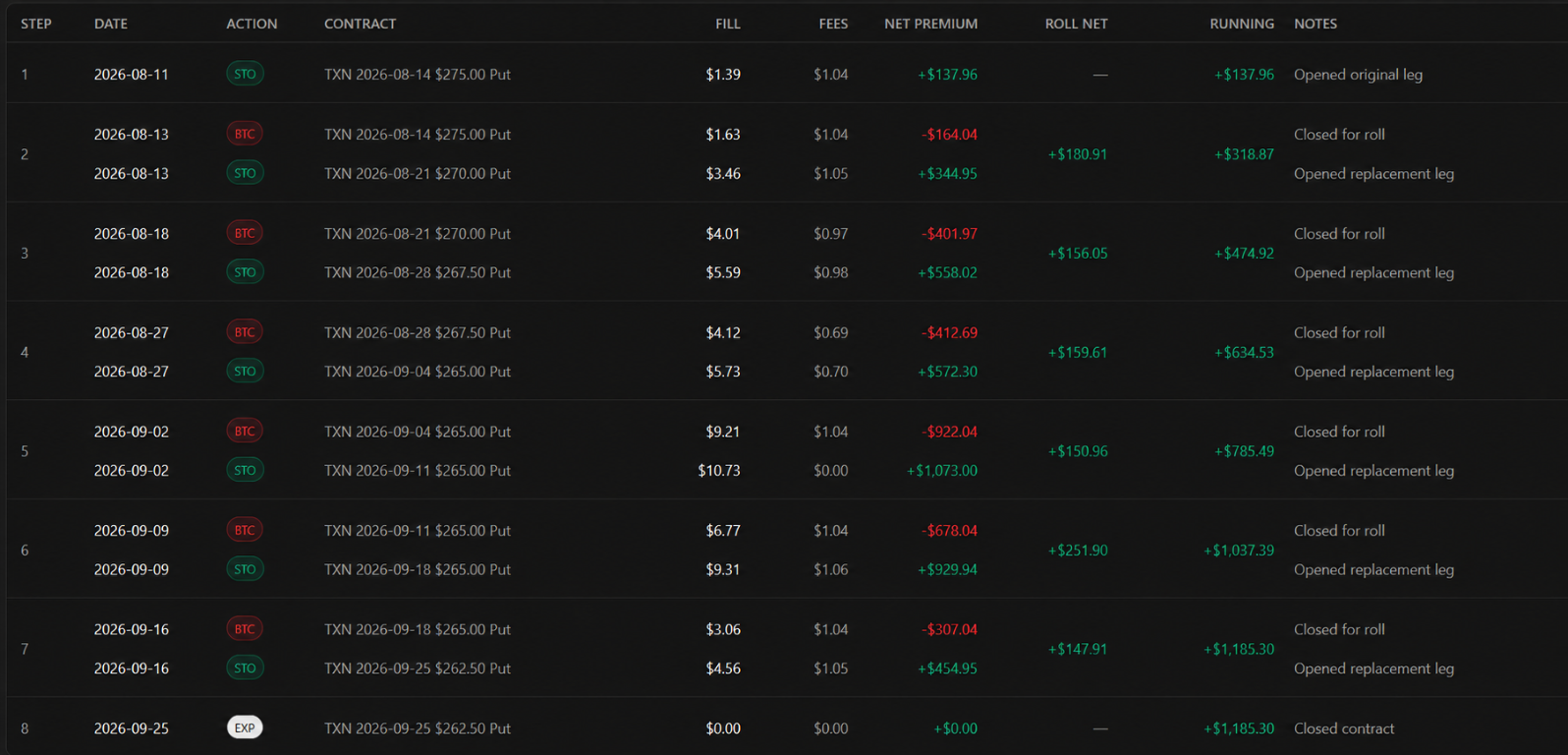
TXN roll chain through September 25, 2026. Click to enlarge.
That was four moves to a lower strike and two weeks where I stayed at $265. Every new expiration was just one week beyond the old one.
The market wasn’t making it easy. SPY closed at $777.88 on August 13 and $754.05 on September 16. TXN itself went from $281.24 when I opened the trade to $254.80 on September 2. That September 2 close was $10.20 below my $265 strike, with the September 4 expiration right around the corner. Even on September 16, TXN finished below the $265 strike I was buying back.
On September 2, I paid $921 plus a $1.04 closing fee to buy back the September 4 $265 put. That old put closed at a $349.74 loss on its own. Then I sold the September 11 $265 put for $1,073. The two transactions together brought in $150.96 more cash.
I still had a short $265 put, and TXN was still below $265. If it kept falling, I’d have to manage it again or be prepared for assignment. Going out one week bought me time, not safety.
I made the same-strike move again on September 9 for a $251.90 net credit. On September 16, I finally got the strike down to $262.50 for another $147.91. TXN recovered enough to close at $278.07 on September 25, so the last put expired worthless and I never took the shares.
Across the original put and six rolls, the chain finished at $1,185.30 after recorded fees. That’s 4.31% of the original $27,500 collateral over the August 11 to September 25 run.
I’m super happy with this one. I lowered the purchase obligation from $275 to $262.50, kept the next expiration close, collected a credit on every roll and avoided assignment. For what I wanted out of a CSP in this market, that’s about as clean as it gets.
It still could have gone the other way. Rolling doesn’t make an underwater put disappear, and assignment can happen before expiration too. If TXN had kept sliding, I’d still have been on the hook to buy 100 shares at my latest strike or pay to close the put. In a healthier bull market, I’d probably be more willing to own the shares and sell covered calls. In this regime, I’d rather play defense and keep that choice open.
Here’s a quick summary of my wheel portfolio’s year-to-date performance. It’s up $14,781.17, or 18.88%. Most importantly to me, max drawdown is still in the single digits at -9.92%, with a 1.38 Sharpe ratio. Since launching the wheel strategy in late June 2025, this portfolio is up 44%, with the same -9.9% max drawdown over that entire period. I finished the week with $114,219.64 in cash, or about 75% of this portfolio’s capital.
I spend about 0-3 hours total per week on trading, on average. This wheel portfolio is only a small slice of my overall market capital. I also buy and hold mega-cap stocks/ETF’s and run other strategies, including swing trading leveraged ETFs. The YTD figures and snapshot here cover the wheel portfolio only, not those other investments.
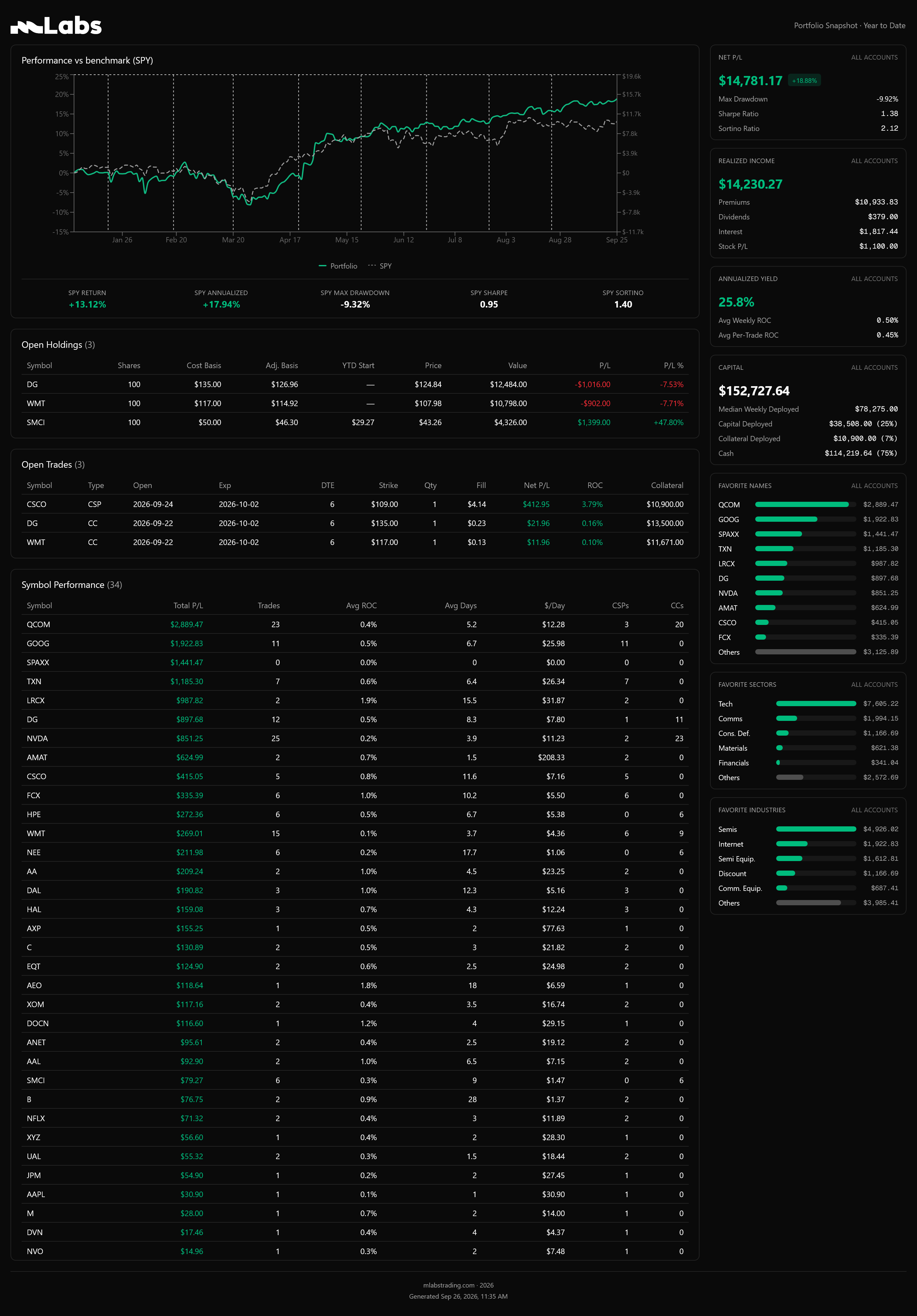
Portfolio snapshot through September 25, 2026. Click to enlarge.
Get notified when we publish new trading insights, results, and strategies.
No spam. Unsubscribe at any time.